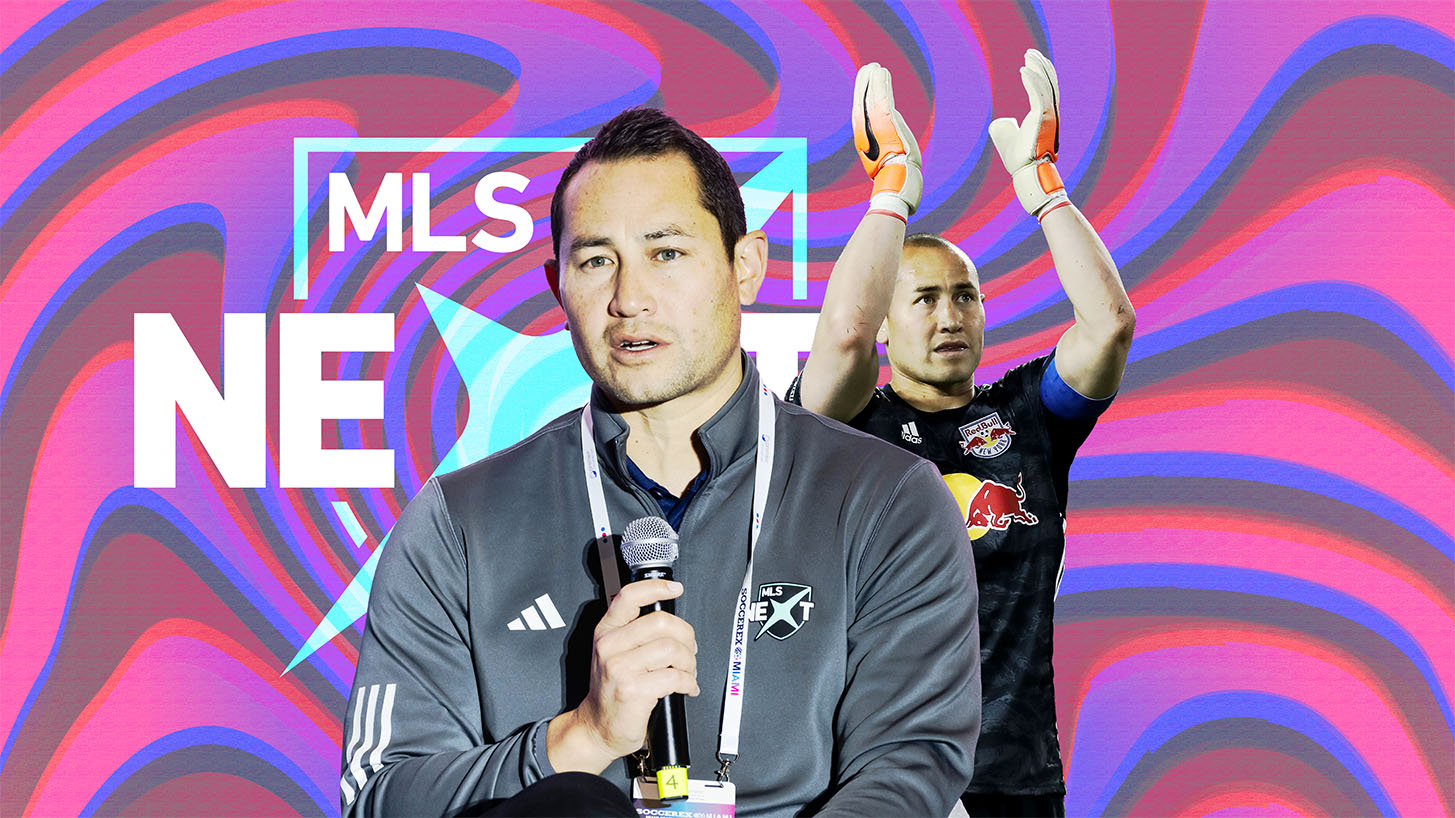
After a lengthy playing career that saw stops in Europe and MLS, Luis Robles is now looking to build a clear pathway for soccer development in the United States as the general manager of MLS NEXT. We sit down with the retired goalkeeper to discuss how the youth soccer league is creating the next generation of American soccer stars.
When Luis Robles left for Germany in 2007, Europe represented a pathway to professional soccer that the United States struggled to offer. Now, through MLS NEXT, he’s helping build the very pathway that was missing when he started his own career.
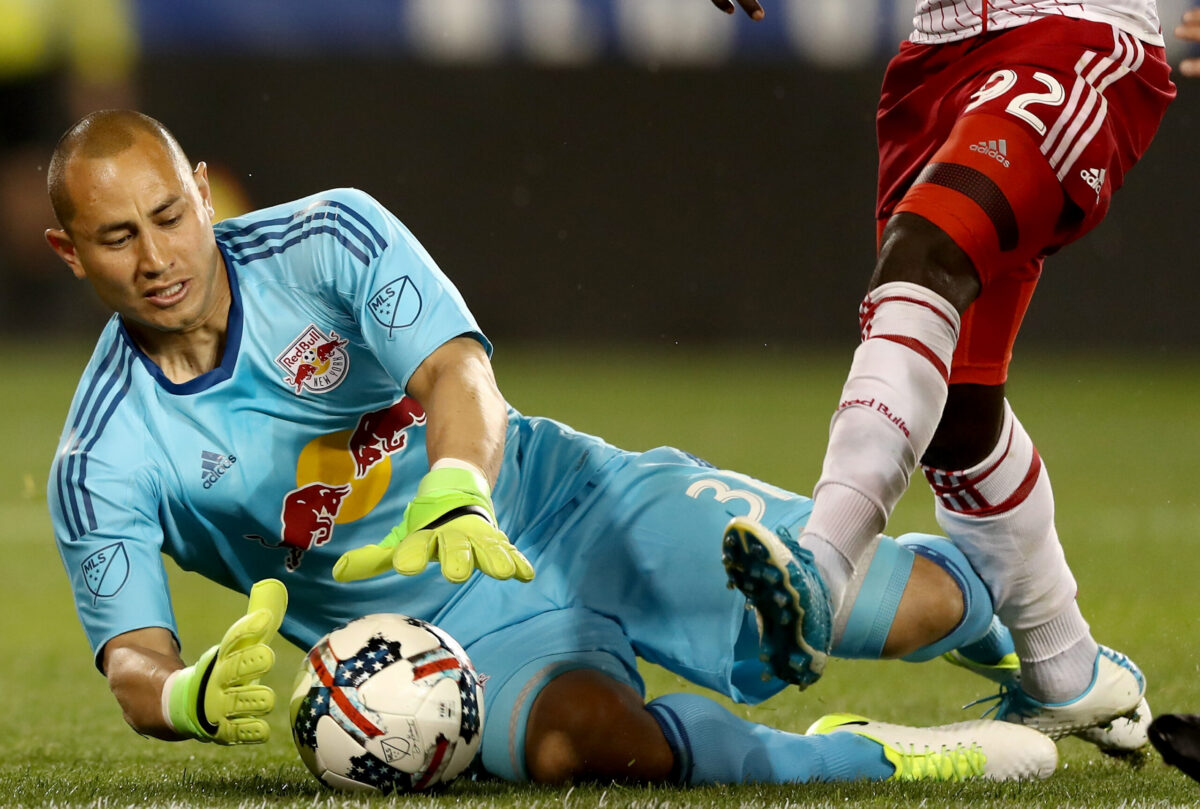
Robles grew up in Southeastern Arizona and developed at Tucson Soccer Academy before heading north to the University of Portland. Rather than start his career with DC United, who selected him with the 50th pick of the 2007 MLS SuperDraft, Robles decided to sign with German side FC Kaiserslautern.
He initially impressed and earned the starting goalkeeping job with Kaiserslautern, but eventually, it was clear that the club and German football as a whole had other plans.
“It was explained to me by both sporting directors at both of the clubs I played for: ‘Hey, we think that you’re a talent, we think that you have a future, but you’re not German,'” Robles said in an exclusive Urban Pitch interview. “They had been instructed by people above them that, ‘We’re going to go all in to develop players that will play for the national team,’ especially at my position.”
Credit to Germany — it worked. Boasting incredible talents including Manuel Neuer and Marc-André Ter Stegen, German goalkeepers were the best in the world, and they played a large part in the run to the 2014 World Cup title.
Kaiserslautern elected to go with Kevin Trapp — who’d eventually represent Germany as well — in lieu of Robles, and he moved to Karlsruher SC in 2010, where he played for two seasons before being released.
A move to the Vancouver Whitecaps looked to be in the cards, but the deal collapsed, leading the 28-year-old Robles to contemplate retirement, even taking a realtor job to acquire health insurance for his pregnant wife. However, Robles persevered and earned a move to New York Red Bulls, and he’d lead the club to its first three trophies: a trio of Supporters’ Shields in 2013, 2015, and 2018.
He departed as NYRB’s Iron Man with a club-record 281 appearances, in addition to an MLS-record 183 straight regular season starts, before spending the 2020 season with Inter Miami. He announced his retirement in January 2021, four months after the launch of MLS NEXT.
After the U.S. Soccer Development Academy suspended operations in the wake of the COVID-19 pandemic, Major League Soccer launched MLS NEXT, which includes the under-13 through under-19 age groups. Robles spent a year as senior manager of programming for MLS NEXT before ascending to technical director in March 2024.
Another promotion followed in March as Robles became MLS NEXT vice president and general manager, and the league has since ballooned to 753 teams across 151 clubs. Two decades after crossing the Atlantic in search of a pathway to professional soccer, Robles is now helping ensure that the next generation of American players won’t have to make the same journey to realize their dreams.
We sat down with Robles to discuss his journey, the new pipeline, and how pay-to-play has affected American soccer.
Urban Pitch: You left for Germany when you were 22. When you were coming through the American youth system, what were the main obstacles preventing youngsters from reaching the top?
Luis Robles: From my path to what is being experienced now, what’s different is clarity, resources, and a collective idea. Coming out of the World Cup, I think there’s momentum behind that collective idea: Why not us? Why not figure out how we can win this thing? When I was growing up on the border of Mexico, there was no clarity to this dream I had of being a professional soccer player.
I asked my club coach, “What do I need to do to one day play at the highest level?” He said, “You play soccer at your club, you win the state cup, play for your state ODP [Olympic Development Program] team, and get held on to the regional pool.”
From there, maybe you get called up, but it wasn’t like, these are the clear steps. If you weren’t living in a population-dense area, you’d go to these tournament showcases, and you’re hoping that you get seen.
ODP is how a lot of guys got seen, and there were top players in Arizona that were not on the ODP team because there was no scholarship. If you have the $700 for the plane ticket, you made the team. Those are the requirements. It was through club and ODP that I got exposure and went to the University of Portland, which had coaches from the UK who knew how to take players to the next level.
When I graduated, I didn’t have an agent, I didn’t get invited to the combine, I didn’t even talk to an MLS team, and then my phone rang and it was DC United: “We’re going to draft you in the second round.” I said, “OK I just want to let you know that I have a plane ticket to go to Germany tomorrow.” The only reason that happened was one of my college teammates went to Millwall and told this agent, “Hey, there’s this really good guy who you should check out.”
I never even had a conversation with this agent, but he said, “Do you want to come on trial in Germany?” I said sure, and he sent me a plane ticket, and I got my first pro deal. To say that there was clarity back then would really be overstating any situation. But what was clear is you were supposed to play local club soccer, and if you had an opportunity, you’d play ODP. With ODP, hopefully you’d make one of these regional teams and get called into the national team, which increased your chances of being seen by a college.
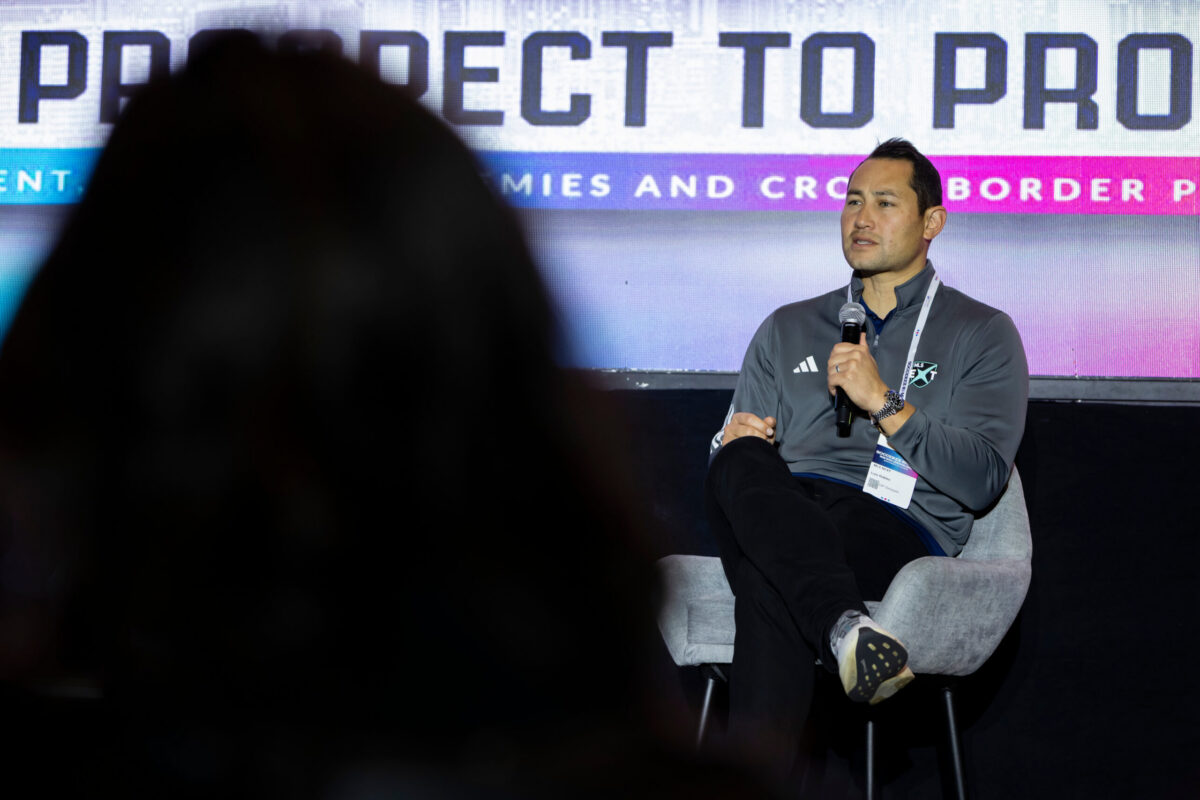
American soccer has relied heavily on college soccer to develop professional players. Do you think that MLS NEXT has fundamentally changed that pathway, or is there the potential to have a balance between MLS NEXT and college soccer?
I think college soccer is so incredibly important. When you look at some of the players that have been drafted in recent memory, that have gone on to do really well at the professional level: Sebastian Berhalter, Miles Robinson, Aidan Morris, Patrick Agyemang, even Daryl Dike, who gave me the hardest shot I’ve ever experienced, these guys have had great success.
What I love about college soccer is the level’s actually higher than it’s ever been because of the international influence. It ends up being a really great space for players that need a little bit longer, because it’s not about arriving first. It’s about arriving on time. For each player, that timing is going to be a little bit different. And when we talk about the pathway, there’s no one pathway.
Now, there are all these different opportunities for development that create a little clarity, and college soccer is part of that. It’s just not under the domain of Major League Soccer. You look at Sergi Solans at Real Salt Lake and Nikola Markovic at DC United, who came from college.
It isn’t necessarily about balancing, it’s remembering that there are multiple resources out there. NEXT is a player development platform from ages U-13 to U-19, and the goal isn’t “this is your destination,” it’s that we keep elevating players to the next level, and the next level could be MLS NEXT Pro, which didn’t even exist five years ago.
When I think about my experience in Germany, I signed with a Bundesliga club and didn’t get my minutes there. I played with the second team in the 3. Liga and trained with the first team. Being around those professionals was an amazing experience that elevated my development. Getting those minutes in the third league elevated my development.
Now, players have options. They could go to NEXT Pro, and they can get that pre-professional experience that could lead them into a professional environment and a professional contract, and then really realize their professional development, or they can go to college, which is also a great experience, and there’s still an opportunity for them to reach all their professional dreams.
You look at Sebastian Berhalter, who was at an enormous academy, and he wasn’t ready. He played a season at UNC, and then he went back to Columbus, and they signed him, then went to Austin and wasn’t getting a lot of playing time, and then he got traded to Vancouver. He was just doing whatever he could to be on the field.
To see his development over the last 18 months, he was one of the best players in MLS before he got sold to Middlesbrough. But even during that period, he needed that time to develop, and that’s what we have now. College used to be the only option. Now there are multiple options for players to develop, as we hope to develop better players that have an impact on MLS and the national team.
Let’s talk pay-to-play. There’s such a massive debate about the right to be able to play youth soccer without going broke, the right to receive a top-class soccer education without living near a major city. Do you think MLS NEXT is filling that void right now?
It’s a big void, but it’s also a void that it can get spun in different ways. At the core, it feels like there’s a transaction that needs to take place. If I’m a customer and I want a great soccer experience and this is what a great soccer experience looks like, it’s not like that just happens overnight. What is a great soccer experience? Do I want it to be free? Where can I go and it’s free?
There are several non-MLS clubs within our NEXT ecosystem that are free to play, but it isn’t the vast majority, whereas 100% of MLS Academies are free to play. What steps do I need to take to get there? Well, I need to be seen. How do I get seen? I need to play for a club, and I need to know where that club is at. I’m hoping my kid gets developed so they can get to that next level.
When you play for that club, there are bills that aren’t paid for by the owner of that club. You’ve got to pay someone to coach your kid, and the better team you’re on, the better that coach’s market value is. Then there’s the cost of the field. If you’re the local club team in my community, it’s free or $30 an hour depending on peak time, but if you’re not hitched to the municipality, it’s $250 an hour. Someone has to pay for the lights. When there are game days, you have to pay for the field again; you have to pay for the referees.
We value the safety of the player and the way that they compete in NEXT; they should always be safe. There’s also a qualified medical professional on site who diagnoses a concussion, and there’s a cost to that. That’s how these fees come about: you have the cost for the fields and coaches. If you’re really serious about it, you wouldn’t just join any team where the coach may not know anything.
The only piece that we really have control over, and that we continue to refine, is travel. The way that we build our schedule based on your geography is that we want it to be as minimal travel as possible. If we can reduce travel, then not only is it great for player development, but it helps families. There’s still a cost to go to some of these events, but we want to make sure that there is a return on that event.
We try to create more access by bringing in more clubs, but I’m not gonna lie, it’s a little more challenging for the kid who’s out in the middle of nowhere.
When I think about our schedule in the Midwest: Kansas City to St. Louis is three-and-a-half hours, Wichita to Kansas City is four hours, Lexington to a team in the Midwest is six hours. Denver is seven hours from Salt Lake City, eight hours from Albuquerque, eight hours from Kansas City. There are just certain parts in the United States where it becomes really challenging.
What we try to do is be creative with the schedule. But again, when it comes to events, we try to minimize the amount of travel that needs to be done. It’s a lot easier to address population-dense areas such as the DMV, Southern Florida, New York/New Jersey, and Southern California. Those areas are not problematic. You can get great competition all over, and we can keep the cost down. But I’m not going to in any way lie to you. There are parts of the country that are really challenging.
There’s all these narratives about pay-for-play, but I was just at a youth sports summit where the CEOs of USA Track and Field and USA Hockey were there, and all these presidents of national governing bodies, and I just asked them, “Do you guys fund any of your sports?” “No.”
Pay-to-play is just part of the sports experience here in the United States. When I went to France and Spain last month, two countries at the forefront of the model of player development and coaching development, and I asked them what their secret ingredient is. There was no singular ingredient, it was a collective.
“We’re going to move in this direction, having that leadership come from the federation and leveraging the massive asset that is their professional league, which then filters down to player development and allows resources to be shared at a real local level.”
It raises that tide. I get excited with the idea that Major League Soccer and the U.S. Soccer Federation are collectively trying to figure this out with other leagues, and what we saw in the past international window was the clarity that a player never had until NEXT was launched.
You look at the guys that just got called into the national team and how well they did, and they’re shining examples of that clarity that we call our clear pathway.
Lastly, what do you think has been MLS NEXT’s biggest achievement in its first six years, and where do you think it has fallen short? If we have this conversation six years from now, what will need to have transpired in order for MLS NEXT to be considered a success?
I think MLS NEXT is already a success when you look at the number of players who came through as teenagers and made their USMNT debut this last international window. NEXT is a development platform that gives them the opportunity to play at the highest level of competition, to continue progressing under top coaches in good environments so that they can succeed professionally and internationally.
I think that’s just one part of it, though. Another part is keeping kids involved in the game and giving them opportunities to see as much of the game as possible, and then you’re hoping that they stay involved in the game as a coach, referee, team manager, or academy director. That’s what it is: creating opportunities that lead to professional soccer contracts. It’s opportunities within the game, because we also want to develop a very robust, rapid soccer culture in this country, and programs and platforms like NEXT can help be a part of it.
There are always areas where we can improve. Access is something that we’re always going to want, but I hope that we’re having a conversation in six years and the progress is not only apparent, but substantial. That we’re able to give and reinvest in ways that we never thought possible, where more players have scholarships and access in a way that we can only dream about. Those are real objectives of ours.
The big one is for one of our players coming through our pathway to compete for the Ballon d’Or. That’s a crazy statement to make, but why not reach for the stars? Why not go for it all? The whole reason that we want to do this is to develop better players, coaches, officials, club leaders, a better league, and the U.S. men’s national team. We want to make progress.
The ultimate KPI in six years? We have a player that came through our platform, playing on the U.S. men’s national team, and is on the shortlist for the Ballon d’Or. A lot of people are going to think that’s crazy, but you know what? When I was growing up in Southeast Arizona, where no one played soccer, I said I wanted to be a professional soccer player, and they thought I was crazy, too.