
Mauricio Pochettino has done something many USMNT fans and pundits never expected: he pulled the rug out from under them, challenged long-held assumptions, and reshaped the national team to reflect his own vision rather than what supporters had spent years fantasizing about.
The United States men’s national team is officially Mauricio Pochettino’s. It took a little longer than many had hoped, but by the time the USMNT’s 2026 FIFA World Cup campaign came to an end, one thing had become clear: if Pochettino remained at the helm, significant changes were coming.
If the first four games of the new 2030 cycle have shown anything, it’s that the team is moving in a different direction. The USMNT won all four matches, three of them convincingly, delivering a run of results that made it feel like the program was finally building some genuine momentum again.
Pochettino introduced 13 new faces while giving opportunities to players who had previously faced heavy criticism from sections of the USMNT fanbase. Under the 54-year-old Argentine manager, the old ways of evaluating players and building this team look to be over.
An era built on cohesion, the right balance of ability and attitude, and, above all, what each player brings to the table has begun. Reputation, club affiliation, and preconceived notions are no longer supposed to dictate who belongs. Under Pochettino, the question is simpler: can you contribute to the team and buy into his vision?
The End of the MLS Taboo

Across two cycles, first under Gregg Berhalter and now under Pochettino, the long-standing taboo surrounding MLS-affiliated players and their supposed lack of value to the USMNT has been put to rest. Pochettino, in particular, has shown that a player’s reputation and the prestige of his club do not necessarily reflect what he can bring to the national team.
Juventus, AC Milan, Borussia Dortmund, PSV, and Celtic might look impressive on a player’s résumé, but Pochettino understood that the squad he inherited had a problem that went beyond talent. Complacency had crept in. Some players appeared to consider their places secure, regardless of their performances, and the Argentine manager was determined to change that.
Drawing on his own experience as a player in Argentina, Pochettino recognized that looking closer to home could uncover something the established European-based core lacked: hunger. Domestic players had an opportunity to challenge the hierarchy, and those willing to seize it could transform the team. The result has been a significant elevation of both the USMNT and the broader national team program.
Alex Freeman was one of Pochettino’s projects that drew skepticism from YouTubers, pundits, and other voices within the American soccer conversation. Yet the former Orlando City right back emerged as one of the standout performers on the 2026 World Cup squad. His development has continued in Spain, where his performances for Villarreal have strengthened the case that he could have a significant future at the highest level of European football.
Sebastian Berhalter faced a different kind of obstacle. His surname had become a lightning rod for accusations of nepotism, a familiar talking point among sections of the USMNT fanbase. But Pochettino saw more than a controversial name. The midfielder had impressed with the Vancouver Whitecaps, particularly through his ability to combine effectively with German legend Thomas Müller.
Despite the noise surrounding his selection, Berhalter delivered on the biggest stage, scoring a superb goal at the World Cup. He has continued to contribute in the post-tournament period, adding two more goals, and has since earned a move to Middlesbrough in the English Championship. His trajectory offers a compelling reminder that a player’s performances should carry more weight than the narratives surrounding him.
Max Arfsten provides another example. Pochettino brought the former Columbus Crew player into the national team picture, and the defender has since joined Berhalter at Middlesbrough. These are not isolated success stories; they reflect a broader willingness to look beyond established reputations and give domestic talent a genuine opportunity to compete.
Five members of Pochettino’s most promising USMNT core currently play in Major League Soccer. For those who remain skeptical of the league, however, that might not be the case for much longer. Young talents such as Neil Pierre, Adri Mehmeti, Justin Ellis, and Julian Hall are attracting attention as potential future exports to Europe, reinforcing the idea that MLS can serve as a launchpad rather than a destination.
For Pochettino, MLS is not a consolation prize or a fallback option. It is a starting point for identifying players capable of challenging the established order. And if those players continue to develop, the league’s contribution to the national team could become increasingly difficult to dismiss.
Playing in Europe Is Simply Not Good Enough
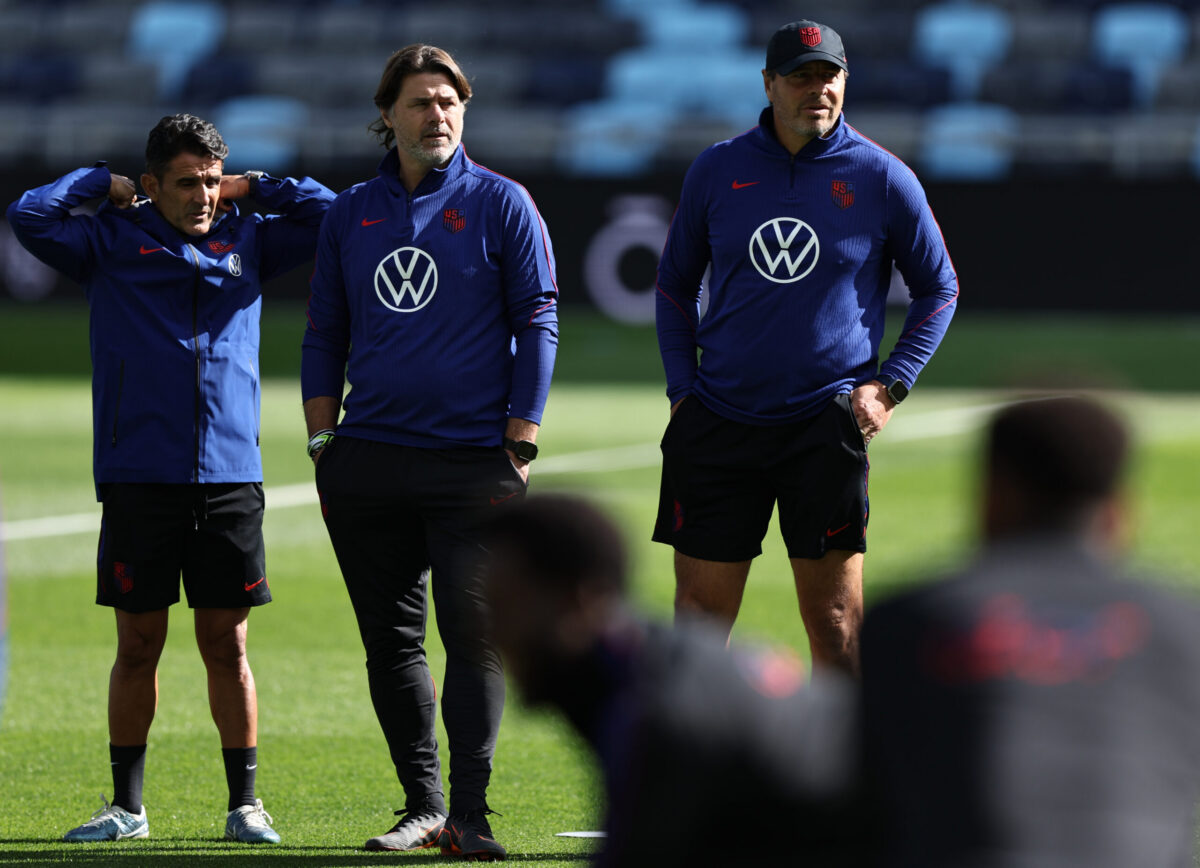
Like many international managers, Pochettino understands that Europe’s biggest leagues are likely to be home to several of his best players. But he also knows that playing in Europe is not, in itself, a guarantee of quality.
For years, sections of the USMNT fanbase treated a European club affiliation as a credential in its own right. If a player was competing overseas, particularly at a recognizable club, that alone could strengthen the case for a national team call-up. Those days, however, are coming to an end. As more American players move abroad, the distinction between playing in Europe and genuinely excelling there has become increasingly important.
Weston McKennie is an interesting case study. The 28-year-old has established himself as a reliable presence at Juventus and has often been among the team’s better performers. Yet his relationship with the club’s supporters remains complicated. His playful personality and occasional status as the team’s class clown have made him a polarizing figure, while his importance to the side has repeatedly come into question, despite being a more or less everyday presence in the starting lineup over the past four seasons including the current one.
Juventus has also fallen on one of its hardest stretches in recent memory, with the club experiencing its longest Serie A title drought since the calciopoli scandal.
But all of that does not diminish McKennie’s ability, as he’s been one of the most important players for the USMNT throughout his career. Rather, it highlights a broader point: playing for a prestigious club does not automatically make a player an unquestioned leader, nor does it shield him from scrutiny. Reputation, personality, and performance are all part of the equation.
Johnny Cardoso presents a different challenge. The midfielder has demonstrated his quality at Atlético Madrid, but his performances for the USMNT have often fallen short of expectations. It remains an intriguing contradiction, and Pochettino may have less incentive to keep searching for answers as alternatives emerge. Berhalter has strengthened his case, Yunus Musah has shown signs of returning to form, and Aidan Morris and Tanner Tessmann have also made compelling arguments for greater consideration.
Tim Weah, meanwhile, has taken on a leadership role as captain of Olympique de Marseille and made an encouraging start to the season. His versatility and experience are valuable assets, but the question is how he fits into Pochettino’s plans moving forward. With competition for wide attacking positions, a strong club start alone will not settle the matter. Weah must continue to demonstrate where he can make the greatest contribution to the national team.

Then there is Christian Pulisic, who remains the country’s standout player and one of AC Milan’s most important attacking weapons. When Pulisic is performing at his best, both club and country benefit. His quality is rarely in question, but his situation illustrates another challenge facing American players abroad: delivering on the pitch is only one part of the story. Pulisic also faces scrutiny back home, while continuing to adapt to another managerial change at Milan as the club struggles to meet expectations in Italy.
The common thread is that a recognizable badge is no longer enough. A few years ago, seeing an American player at one of Europe’s biggest clubs might have been sufficient to generate excitement among USMNT fans and pundits. Today, Pochettino is looking for something more substantial.
He wants players who can perform, adapt, compete, and commit to the collective. Talent matters, but so do attitude, discipline, mentality, and the willingness to earn a place rather than assume one.
That is where Pochettino’s approach represents a significant shift. He is not interested in maintaining a hierarchy simply because it has existed for years. If a player in MLS offers more than an established European-based international, the domestic player deserves an opportunity. And if a familiar name fails to deliver, playing for a prestigious club will not necessarily save him.
Has Pochettino broken down every barrier? Has he found all the answers? Of course not. There is still work to do, and the national team remains a project in progress. But the early signs of this new phase suggest that he is operating from a different playbook.
Rather than simply trying to make the players available to him fit a predetermined vision, Pochettino appears increasingly willing to reshape that vision around the players who demonstrate they deserve to be there. That means making difficult choices, challenging established assumptions, and accepting that some decisions will not sit well with everyone.
For the USMNT, that could be the most important change of all. The days of automatic selections, unquestioned reputations, and European club affiliations carrying disproportionate weight are numbered.
Pochettino is making it clear that nobody should be guaranteed a place, and nobody should be dismissed because of where they play.
In American soccer, some taboos have lasted far too long. It is time to break them.