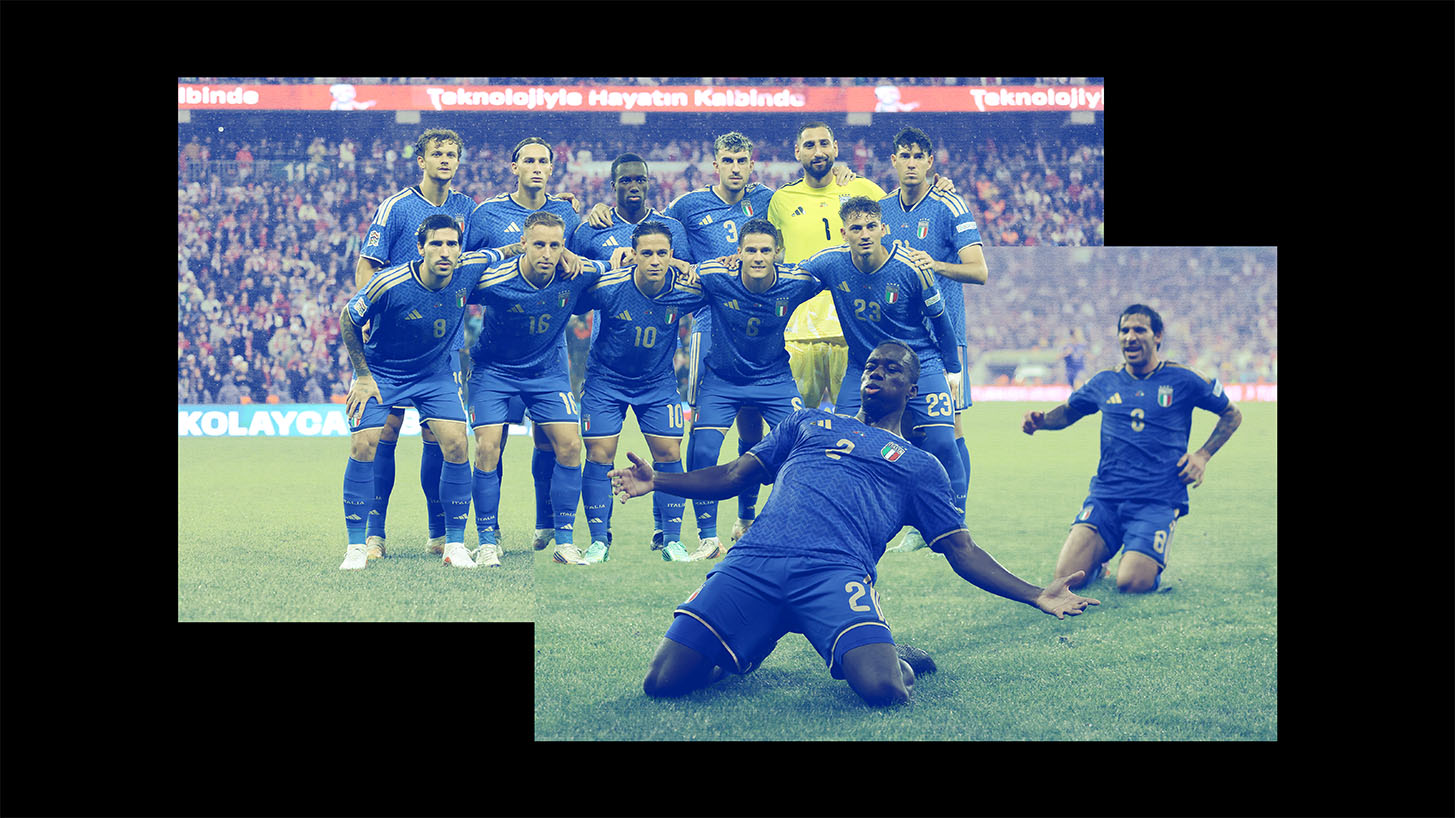
In the midst of a massive lull that has included three straight World Cup absences, Italy is finally beginning to select a more diverse squad, which could be the boost the nation so desperately needs.
Italian football has been plagued by several “new eras” in the last few years.
Some have proved to be false dawns that led to another dead end, best exemplified by the Azzurri winning the 2020 European Championship (played in 2021) only to fail to qualify for the 2022 World Cup less than a year later.
The EURO 2020 title has increasingly felt like a one-off over-performance which simply can’t be replicated.
That feeling was only magnified at the end of Italy’s wretched March 2026 evening in Zenica, where the team’s third straight failed World Cup qualifying campaign came to an end. As a reaction, calcio scrambled around, yet again. Debates unleashed about the lack of grassroots attention, the surprisingly few Italians in Serie A, and the clueless approach of those running the sport. As a result, Italy manager Gennaro Gattuso and sporting director Gianluigi Buffon both resigned, and a new-look Italy side entered the fray, albeit with a familiar manager.
Roberto Mancini returned to the Azzurri managerial hotseat, amidst the promise of a new era that could well and truly drag Italy out of the abyss. While it is a cliched term by this point in calcio history, there seems to be something starkly different about things right now, the most obvious being the increasingly diverse makeup of the current squad.
It isn’t to say this wasn’t the case in previous decades. Indeed, Mario Balotelli’s heroics at the 2012 European Championships are a core memory for the younger Azzurri faithfuls. The ex-Manchester City man was undoubtedly a much more pronounced and expressive individual than a certain Fabio Liverani, who became the first player of African origin to play for the Azzurri. Liverani featured three times for Italy and had successful spells as a player with Lazio and Fiorentina in the 2000s.
But for a long time, players like Balotelli and Liverani were largely exceptions. And for a long time, it did seem as if the setup was brimming with talent that could, in one way or another, match the quality of national teams that would constantly challenge for silverware. One look at Italy’s squad for the 2006 World Cup says it all, as no opposition had the wealth of resources that Marcello Lippi’s side had in that era. It was packed from top to bottom and to many, there was no real need for change.
But in the background, the calamitous Calciopoli scandal was brewing and several key players were approaching the last few years of their career. This was a recipe for disaster, as funding into the grassroots was reduced drastically and clubs started resorting to surviving in the short-term instead of drawing long-term plans to thrive. The drop in quality for the Azzurri in the next few years was clear to see — the 2006 final is the most recent World Cup knockout stage match Italy has played in.
There is also a larger political perspective as well. When nations like Germany, France, and England have been far more open to integrating immigrants, it hasn’t stood true for Italy.
The case of Chelsea’s Honest Ahanor stands as a real example. The young defender couldn’t earn Italian citizenship until he turned 18 because of the ‘jus sanguinis’ principle, which says that children born to foreign parents in Italy aren’t automatically granted the country’s citizenship. They have to wait until they turn 18, which is in stark contrast to how the regulation operates in countries like the United Kingdom, France, and Germany.
Even in Spain, children of immigrant parents are entitled to citizenship at age of 1, which makes things much more favorable. It is fitting that it was Lamine Yamal, the child of Moroccan and Equatoguinean immigrant parents, played a big part in La Roja’s titles at the 2024 European Championship and the 2026 World Cup.
The Azzurri meanwhile, nearly lost out on Ahanor, who could’ve easily chosen Nigeria if Italy had moved late. Even Michael Kayode was considering representing Nigeria instead of the Azzurri, as he too didn’t get Italian citizenship until he turned 18, having been born to Nigerian parents in the northern town of Borgamanero. Italy faced a real risk of missing out on the Brentford defender, until Mancini decided to call him up at the recent international break, ending any uncertainty surrounding his future.
Kayode has thrived, deservedly replacing Giovanni Di Lorenzo, whose best days in the national team setup are well past him.
The Bees star is a classic case of a change in perception at the highest level of the Italian game. It has come at a time of immense desperation and when calcio finds itself at rock bottom. The good times slipped and something, finally, had to change.
In 2014, then-FIGC president Carlo Tavecchio exposed himself and the Italian game as largely regressive in an infamous interview where he referred to Black players as “banana eaters” that don’t deserve to play the game in Italy. Deservedly, he was banned for those statements but in hindsight, it lays down a convenient context for a team like France to tap into immigrant communities perfectly.
When suburbs around French major cities became a hotbed for talent and the setup had come crashing in the 2010s, it proved to be a game-changer for Les Bleus. That continues to be the case and that will be the case for decades to come.
Italy can draw inspiration from that, even if citizenship regulations will obviously draw a line. Mancini specifically has become a shining light in recognizing that the talent pool needs to increase and calcio needs to take more risks. It has sent a message across the setup that gone are the days of going with the tried and tested ways and it is finally time to expand horizons.
That has also led to lesser known players like Mohamed Ali Zoma now being a part of the Azzurri setup. The attacker was born in Italy to a Burkinabe father and an Ivorian mother. He came through the famous AlbinoLeffe academy before moving to Nurnberg in 2. Bundesliga. Even with his impressive performances for the German club, there is every chance a player like him would have slipped through Italy’s hands several years ago.
But that isn’t the case anymore. Famously, it is Mancini himself who has brought Kayode into the fold when Gattuso was happy to stick with Di Lorenzo or even use Gianluca Mancini at right back when needed. In his previous stint as Italy manager, the ex-Manchester City boss spotted striker Matteo Retegui, who was also eligible to play for Argentina, bringing him into the fold in 2023.
An approach like this, as Tavecchio’s comments indicate, would’ve been unthinkable in the previous decade. The arrogance has now been stripped away and in a lot of ways, the average Italian doesn’t exactly feel the same connection with the Azzurri as they did in the early 2000s. Decades of disappointment has led to that, providing a possible opening to the immigrant population to make the country proud.
This is leaving the FIGC setup with no other option but to adapt to changing times, even if the country as a whole may not want that.
It is also largely definitive that during Italy’s loss to Bosnia in Zenica, it was Moise Kean who was on the scoresheet for Gattuso’s side. The striker was born to Ivorian parents in 2000, which was right in the middle of a period of African immigration into Italy.
Kean and Balotelli have long been compared to each other, and not just in a way that pigeonholes one Black player into the bracket of another. Kean saw himself in Balotelli while growing up near Turin, and Balotelli has come to Kean’s defense and support multiple times as the striker has been the target of racial abuse throughout his career. There is a chance that without Balotelli, there may never have been a Kean. Balo walked so that Moise could run.
There is a chance a young kid who took birth in Italy to African parents could be watching the likes of Kean, Kayode, Ali Zoma, and Destiny Udogie don the famous maglia dell’Italia and harbor dreams of replicating them in the years to come. It would give that child hope of achieving something in the game and have a larger impact in the sport.
That is what Mancini and Italy right now would hope for. The Italian government continues to clamp down on immigration, going to the extent of blockades preventing migrant boats from entering Italian waters, but the national team and this fresh approach to selection can set the tone for something bigger. If anything, it will be a “new era” that can actually save the Italian game in the long run.