There’s nothing like a good derby match. And while there are plenty of entertaining rivalries across North America, there are a few that may have flown under your radar.
Years ago, I worked with a very artsy guy. He listened to classical music, read poetry, and held philosophical convictions that were far more sophisticated than those of us mere mortals. I would use Casual Fridays to wear my extensive collection of soccer jerseys, occasionally provoking in this learned man raised eyebrows and glib remarks. One such Friday, he hit me with “I just don’t understand why people like sports. I’ll never get it.”
I chose not to engage, instead offering a vague “to each his own” explanation. I could have brought up the sense of community that fandom creates, or the unexpected human drama which unfolds before our eyes with a defined set of rules that we all understand, or the escapism sports provide from the everyday post-capitalist hell we all live in.
But when I really thought about it, I kind of realized that, while all of these explanations are nice, they omit a fundamental reality of sporting competition: it gives us an excuse to hate something.
Hate is normally a word that’s reserved for only the most bilious, reprehensible acts in our society. But sports hate is different. Sports provide an outlet, a permission structure, for a tribalistic, us-versus-them mentality that would be best left out of, you know, actual society. We come together on the field of play for 90 minutes, absolutely loathing the cretinous villains that have the temerity to support the other team, and afterward we’re free to carry on with our enlightened, democratic, inclusive lives. It really is the perfect catharsis.
I think that’s why local derbies are so much fun. Proximity and familiarity certainly do breed contempt, and local soccer fans have been quick to embrace hating their closest rivals. From the highest divisions right down the lowest, fans across this mighty continent of ours have delighted in ratcheting up the trolling, the ire, and the social media cheap shots when it comes to dealing with their geographical rivals.
Let’s take a look at some of the feistiest local rivalries across North America, and see what kinds of innovations our most hateful soccer neighbors have cooked up.
Derby Del Camino Real: El Paso Locomotive FC vs. New Mexico United
View this post on Instagram
The name of this USL Championship rivalry harkens back to the Camino Real de Tierra Adentro, roughly translated as “The Royal Road of the Interior,” which was a Spanish colonial-era path which served as a major trade and migratory route stretching from Mexico City to what is today Northern New Mexico.
There has traditionally been a little bit of beef between the good folks of El Paso, Texas and the state of New Mexico, thanks in no small part to the rabid college football rivalry shared by New Mexico State and the University of Texas at El Paso.
While the soccer rivalry between the two does not stretch back over 100 years like its pigskin counterpart, it doesn’t lack any of the vitriol we associate with the best local derbies.
Both clubs entered the USL in 2019, and disliking the other came quickly. Due to travel restrictions spurred on by the 2020 pandemic, New Mexico United and El Paso Locomotive were forced to play one another six times in a single season. This string of matches culminated in that season’s Western Conference semifinals, in which El Paso triumphed 5-3 on penalties after coming through extra time tied 1-1.
A four-hour drive (on a good day) separates these two American Southwest powerhouses, and there is no love lost between the desert-dwelling neighbors. There have been 23 matches in the derby’s short history, with New Mexico winning eight times and El Paso six.
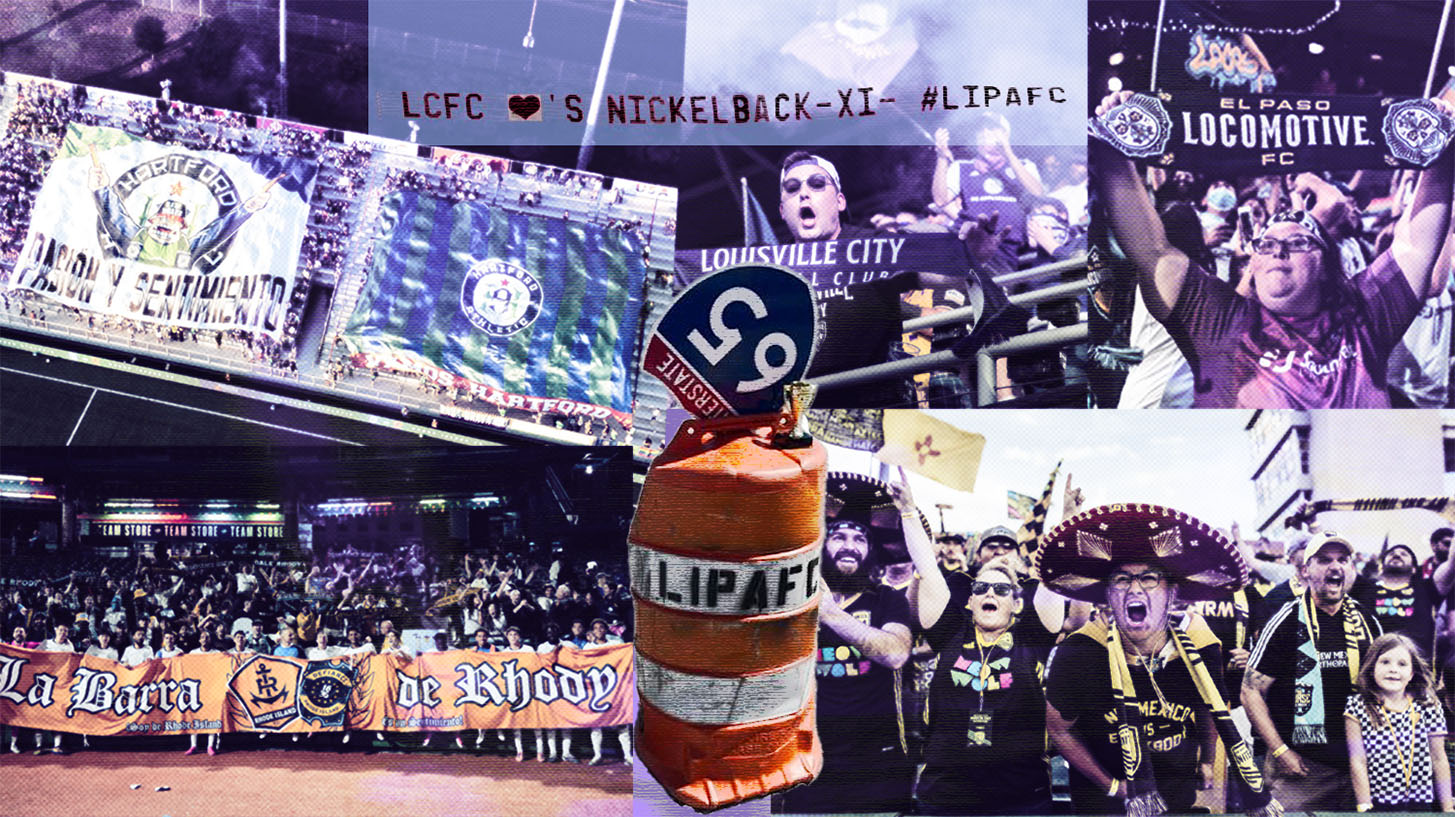
The flames of rivalry are stoked by each club’s official supporters’ groups: New Mexico United’s The Curse and Locomotive’s 8th Notch. The former grew to loathe above all others Locomotive’s Spanish defender Javier Monsalvez Carazo, better known by his nom de guerre Yuma. El Paso’s first ever signing in 2018, Yuma received a straight red card in the first match between the two sides in May 2019. Club captain until the end of the 2024 season, Yuma was regularly and roundly trolled by The Curse members at each away game at New Mexico United’s Isotopes Park.
In their most recent meeting, New Mexico claimed the honors in a true six-pointer on the final day of the USL Championship regular season. United’s own Valentin Noël scored a stoppage-time winner in the 94th minute off an assist from Arsenal legend Gedion Zelalem. With the result, New Mexico leapt to the top of the Western Conference, leaving El Paso Locomotive down in the doldrums of third place. But don’t worry: the clubs are currently on a dramatic collision-course to meet in the Western Conference finals!
Toronto Derby: Toronto Croatia vs. Serbian White Eagles
The biggest cities of modern-day North America are vibrant patchworks of proud immigrant communities, and Toronto is a shining example. Anyone who claims that multiculturalism doesn’t work needs to spend a day strolling around Toronto’s picturesque neighborhoods on the shores of scenic Lake Ontario. (Just don’t go in January like I last did.)
Soccer has long been a way for members of various diaspora communities in Toronto to come together and keep alive the cultural traditions of their homelands. Toronto Croatia was founded in 1956 by Croatian immigrants, and quickly developed into a vibrant community space and sporting institution. Serbian White Eagles, on the other hand, trace their roots to Hamilton, Ontario in 1963, with the club relocating to Toronto in 1968. Each club made signing ethnically Croatian or Serbian players and coaches a priority, a tradition that continues to this day.
Dating back to the 1960s, Croatian and Serbian expats residing in Canada’s largest metropolis faced a considerable amount of strife, owing to the political uncertainty back home in Yugoslavia. The name “White Eagles” itself is a nod to the Serbian paramilitary organization of the same name that originated as a pro-fascist, anticommunist insurgency during World War II. A later group of the same name participated in the Balkan Wars of the ‘90s and were credibly accused of a handful of war crimes, but we can hardly blame the soccer team named in the 1960s for all that.
Both clubs competed in Canada’s erstwhile Canadian National Soccer League, and came to prominence at a time when soccer culture was seen as incompatible with the North American sports scene. Ethnic clashes between Croatians and Serbians in Toronto occasionally spilled over into soccer fandom, which was then used by some pearl-clutching Canadian politicians as evidence both of the supposed unruly nature of Balkan immigrants and the notion that soccer was nothing but an aperture for violence and hooliganism to infiltrate an otherwise collegial sporting culture.
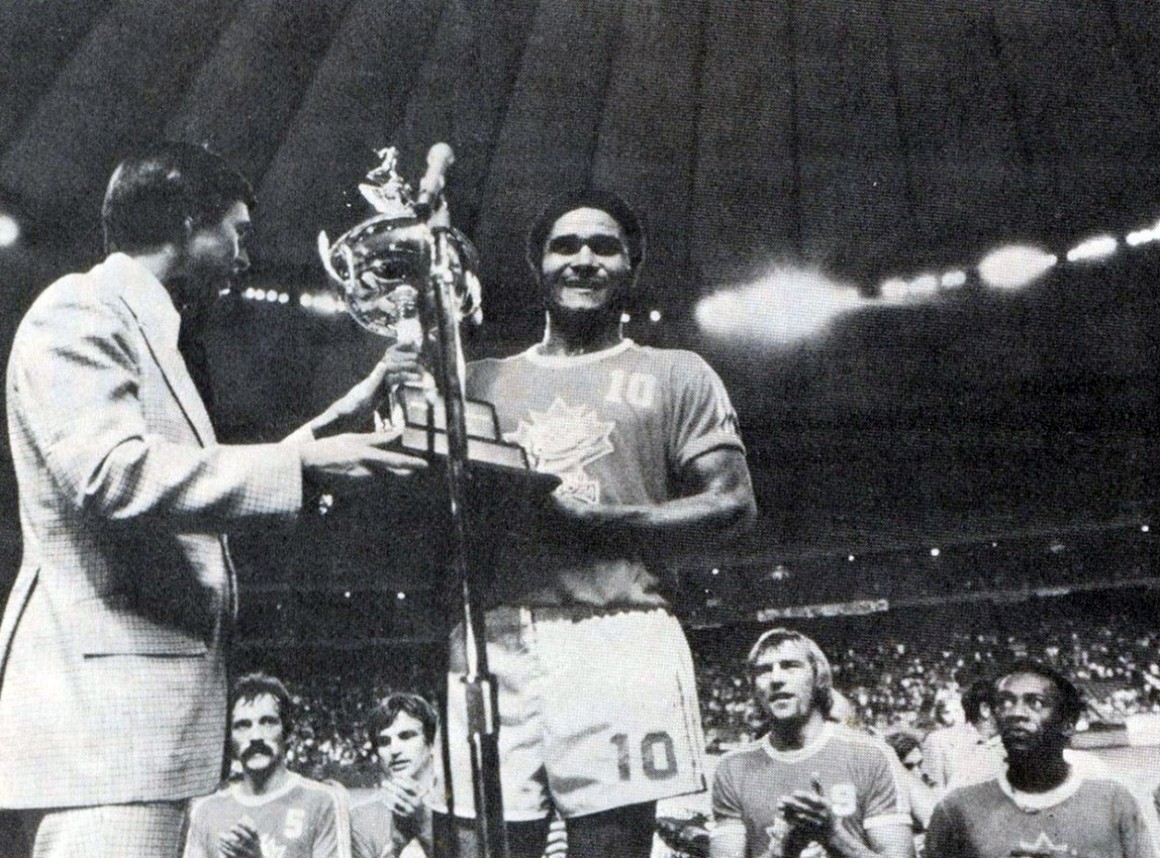
The clubs of yore were successful, with Toronto Croatia capturing eight CNSL titles and even joining the NASL from 1975-78, purchasing a 50% stake in the Toronto Metros and rebranding to the Toronto Metros-Croatia. While in the NASL, the club won the 1976 Soccer Bowl, led by Portuguese legend Eusebio, but it would return to the CNSL in 1979 until the league’s collapse in 1997.
The White Eagles claimed the 1974 CNSL regular season title, and became the first Canadian team to qualify for the CONCACAF Champions Cup in the same year. They’d narrowly be eliminated by Mexican side CF Monterrey, but only after participating in a good old-fashioned bench clearing brawl in the process!
However, the White Eagles withdrew from the CNSL in 1981, and the rivalry would lay dormant for 25 years.
Things would reignite in 2006 with the rebranded Canadian Soccer League, where the Serbian White Eagles and Toronto Croatia would compete in the new “International Division” composed of various clubs representing the myriad ethnic minority groups spread around the Greater Toronto region. They instantly became the dominant sides in the division, with the White Eagles claiming the International Division crown in 2006, and in 2007 they nosed their Croatian rivals by four points to claim the regular season title. The passion of the local rivalry reportedly boosted match attendance figures across the entirety of the CSL.
But perhaps the defining moment of this intense rivalry came in the 2007 season’s championship match. Both Serbian White Eagles and Toronto Croatia stormed through their respective halves of the playoff bracket, and they were scheduled to play a one-off final match at Toronto’s Esther Shiner Stadium on October 27. But owing to a couple of dust-ups during the regular season between passionate supporters of both clubs, the decision was made to convert the final to a two-legged affair on consecutive days, with the first match hosting only Toronto Croatia fans, and the second solely White Eagles fans.
The decision, egged on in large part by local politicians, enraged club officials of both sides. The ethnic strife of the Yugoslav Wars, only a little more than a decade old in the memories of both fanbases, was used as a sort of justification. CSL Commissioner Cary Kaplan hemmed and hawed, offering this milquetoast explanation to a local Toronto newspaper:
“We have to err on the side of safety. We haven’t had any major instances. No one has ever been hurt. But there’s two volatile groups and there’s a history…we had a lot of games. Italy against the Caribbean, no problems. It’s the history that’s there…nobody is necessarily happy. But we feel good that it’s the right thing to do.”
Supporters of each club vehemently denied the idea that there was any danger of violence as a result of the fixture, positing that they maintained a healthy dialogue and respect between the clubs. The two-legged final went ahead as scheduled, with Toronto Croatia triumphing 4-1 on aggregate, with all of the goals coming in the first leg in front of a crowd of 3,000 raucous Croatia supporters.
This once proud rivalry went out with a whimper in 2016, when Toronto Croatia decided to jump ship from the CSL to participate in a nascent developmental league. The club now plays in Canada’s National Arena Soccer League. Meanwhile, Serbian White Eagles continue to ply their trade in the Canadian Soccer League.
Only time will tell if this not-so-friendly rivalry will be renewed in the near future. But if it does, you’d better believe that I will be lobbying Urban Pitch pretty hard to pay for me to go cover the game!
El Clamico: Hartford Athletic vs. Rhode Island FC
Ah, Southern New England. Home of cable-knit sweaters, old money, and bizarre accents, this geographically smushed collection of states surely isn’t big enough for two USL Championship clubs, right?
Don’t tell that to Rhode Island FC, who instantly became the annoying younger brother to Hartford Athletic upon its inception in 2024. Hartford had previously enjoyed a privileged status as the region’s only professional club since its inaugural season in 2019, and the addition of RIFC has given us one of the great rivalries in North America.
Hartford, Connecticut and Pawtucket, Rhode Island are separated by a mere 75 miles. While in England, this type of geographical separation would make for a far-flung away day, here in the good old US of A that’s basically right next door.
Rhode Island FC, every bit the noisy neighbors, have a slight edge on their elder rivals, with three wins compared to Hartford’s two in the nine total derby showdowns. Rhode Island even went as far as claiming the USL Championship Eastern Conference title in its first season of existence.
In July 2025, Hartford goalkeeper Anthony Siaha poured gasoline on the fire by dramatically shushing Rhode Island faithful after a contentious 0-0 draw. Siaha played the hero for Hartford on the day, recording a beauty of a point-blank save to deny Rhode Island’s Albert Dikwa in the second half. The game itself was especially heated, given that it was broadcast nationally on CBS, the first time that either club had been showcased so widely.
In the aftermath of that match, the friendly nature of the rivalry was disrupted by reports of Rhode Island FC fan violence against traveling Hartford Athletic fans. As the contingent of Hartford fans were walking back to their bus through the parking lot, they were reportedly harangued and harassed by a gaggle of Rhode Island fans. One in particular threw punches at various Hartford supporters, and was reportedly arrested in short order by the Pawtucket Police Department.
Still hot and bothered from those recent antics, the teams met again seven days later in the USL Cup. The game ended 2-2 after extra time, and Hartford prevailed 4-3 on penalty kicks.
While the two clubs are certainly bitter enemies on the pitch, this is a rivalry that has just as much to do with off-the-field animosity. Hartford fans will claim that Rhode Island is best avoided, since there’s not really anything to do there. The Rhode Island faithful tend to claim that Connecticut really only serves as a convenient thoroughfare to New York City.
But the real bone of contention? Seafood.
When discussing the new regional rivalry, representatives of Hartford’s Raza Brava supporters’ group and Rhode Island’s Defiance 1636 continually debated the supremacy of their own regional fruits of the sea. Each locale claims to have the best clams in the world, and some of the best methods for preparing them. Hence the beautiful moniker for the derby was born: El Clamico.
But which side cooks up the best seafood? I guess it’s up to you to book a trip to the Southern New England Coast and find out for yourself.
LIPAFC: Louisville City FC vs. Indy Eleven
Separated by about 115 miles and joined by Interstate 65, Louisville and Indianapolis can be considered “Midwest Close.” But the relatively far distance between them hasn’t prevented Louisville City FC and Indy Eleven from forming a rivalry that is both bitter and playful in the best of ways.
The two clubs had their debut seasons one year apart from another, albeit in different leagues.
Indy Eleven’s maiden season was in 2014 in the now defunct North American Soccer League, and Louisville entered the USL ranks in 2015, replacing Orlando City SC, who made the jump up to MLS. I dare you to find a more American soccer-coded origin story. Nonetheless, sort of like wild animals with no natural predators, each was allowed to flourish in its own habitat without fear of losing fans.
All that changed when Indy made the switch to the USL in 2018 after the NASL’s collapse. It was no secret that the club sought MLS expansion, but it was passed over in 2017 with the announcement of Nashville SC. Anyone else hear the “Star Spangled Banner” playing faintly in the background?
The fanbases of Indy Eleven and Louisville City, perhaps desperate for a rivalry to spice up their soccer-viewing experience, leapt in headfirst and began creating an elaborate web of lore. This culminated in the naming of the rivalry: Louisville-Indianapolis Proximity Association Football Contest, or LIPAFC.
A tongue-in-cheek social media campaign has explained that the rivalry’s roots can be traced back to the ruins of Pompeii, through the Civil War Era, and a fictitious 1926 clash that ended in a 36-35 penalty shootout.
It’s not all fun and games, however. The hateful rhetoric reached a crescendo in 2022, when Indy supporters arranged for an airplane to fly over a Louisville match, with a trailing banner that read: “LOUISVILLE CITY LOVES NICKELBACK.”
Unforgivable.
The clubs have contested a total of 27 matches, with Louisville City having claimed 13 victories to Indy Eleven’s six. The most consequential of these fixtures was surely the 2019 Eastern Conference final, in which Indy held a tenuous 1-0 lead heading into stoppage time. Louisville’s Antoine Hoppenot notched a dramatic equalizer, and City went on to prevail 3-1 in extra time. The contest has been widely cited as one of the best matches in USL’s history.
But what’s more fun than action on the pitch? Weird trophies off it!
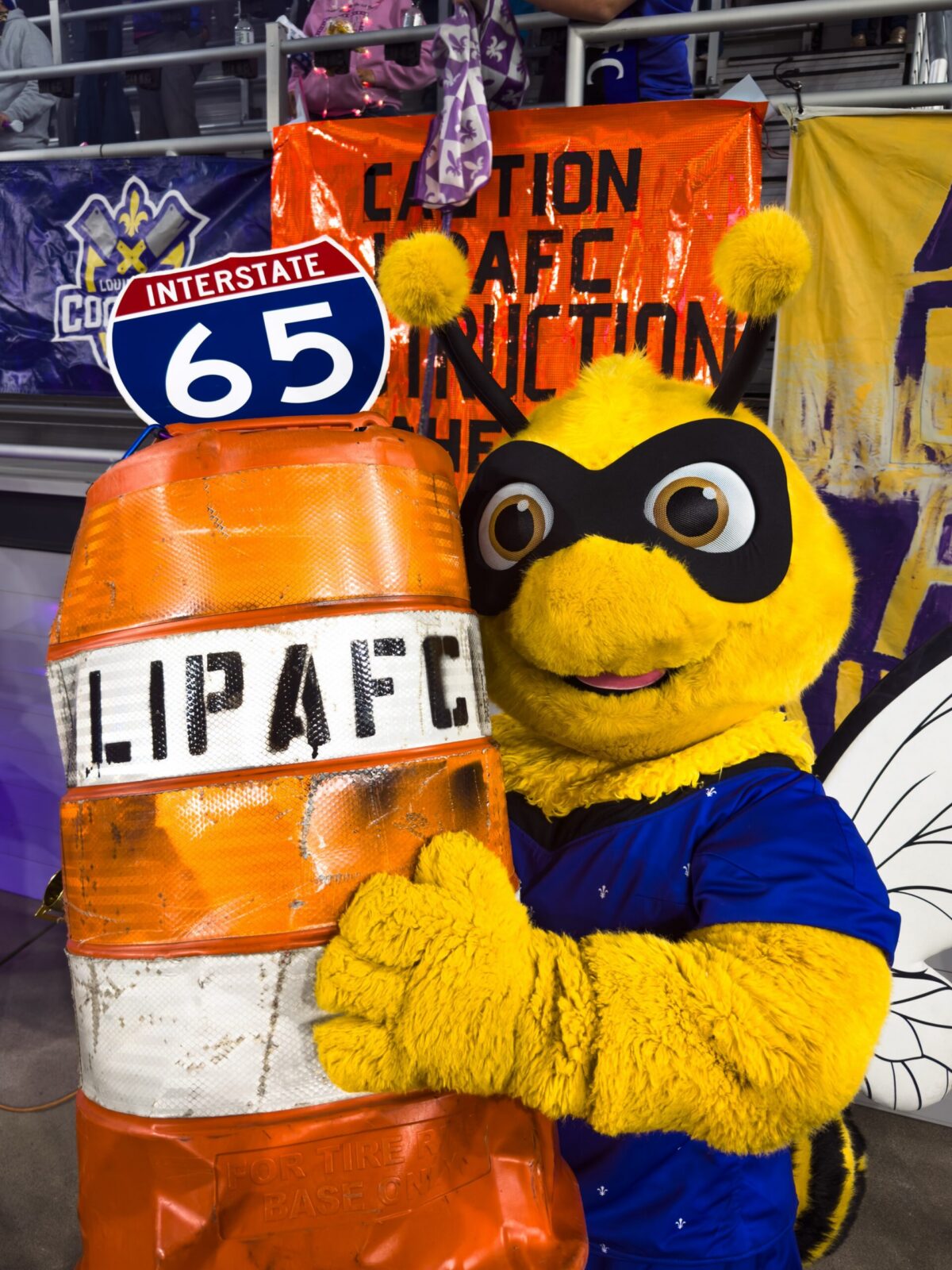
The winner of each LIPAFC fixture claims the iconic, fan-made “LIPAFC Barrel Trophy,” a weathered orange traffic barrel with an Interstate 65 road sign wedged into the top and a golden, plastic cup duct-taped to the side.
The fan representatives of Indy Eleven and Louisville City have deftly demonstrated how to grow and sustain a rivalry in the internet era. Toeing the thin line between goofy cosplaying and real, deep-seated animosity, these two clubs can teach us all a thing or two about how to keep the fire of mutual hatred burning.


